

Voice-based evacuation systems are gaining ground over traditional acoustic systems
In fire safety, every second counts. For decades, sirens have been the most common system for raising the alarm in an emergency. However, advances in technology and experience gained in real-life situations have established voice evacuation systems as an increasingly widespread alternative in safety projects.
Although in many buildings regulations do not require the installation of EN 54-certified systems, an increasing number of engineering firms, safety managers and building owners are choosing to install them voluntarily, as they consider them to represent a substantial improvement in evacuation management and the protection of people.
Clear communication versus an audible signal
The main difference between the two systems lies in the method of communication. Whilst a siren merely emits an audible warning signal, voice evacuation systems allow clear and direct messages to be conveyed.
This capability reduces uncertainty at critical moments, when occupants may not know whether it is a drill, a technical fault or a real fire. Verbal information provides immediate context and facilitates faster and safer decision-making.
Furthermore, the human voice helps to reduce panic and confusion, particularly in high-occupancy environments or where users are unfamiliar with emergency protocols. Structured messages act as a guide, promoting more orderly evacuations and preventing improvised behaviour.
Systems that can be adapted to different levels of complexity
Beyond mere communication, voice evacuation systems offer a level of flexibility that sirens cannot match. It is possible to broadcast zone-specific messages and adapt instructions in real time as the emergency unfolds.
This feature is particularly useful in complex buildings, industrial facilities or large retail spaces, where not all areas require the same response at the same time.
In this context, UDE develops solutions tailored to different project scales. The UDEVAC-500 system is designed for small and medium-sized installations, whilst the UDEVAC-6100 system is designed for large-scale infrastructure and high-demand projects, featuring advanced decentralised systems on redundant LAN networks.
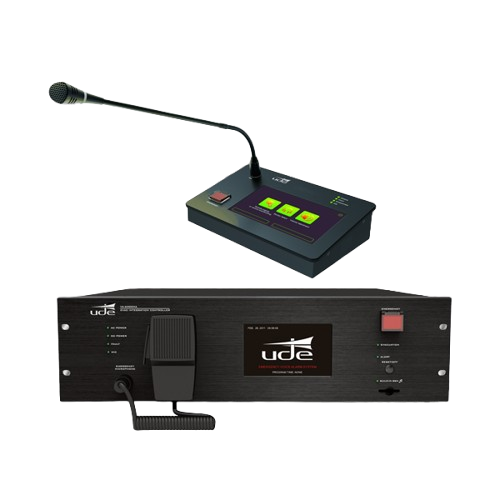
In addition, the UDE projects department works alongside engineering firms, system integrators and installers to design solutions tailored to each specific case, striking a balance between technical requirements, safety standards and cost-effectiveness.
The role of prevention beyond legal requirements
The difference between a generic audible signal and a system capable of conveying clear instructions can be decisive in a hazardous situation. In this regard, the move towards voice evacuation systems improves information management during an emergency, where precision and the ability to guide occupants play a key role.
Consequently, the focus shifts from detecting the emergency to how the evacuation is organised once the system is activated, which helps to strengthen operational safety in critical situations.
Although in many cases these systems are not specifically required by current regulations, their adoption is increasingly seen as an improvement in the actual capacity to respond to emergencies, particularly in terms of managing the evacuation and protecting people.